Metasearch. A Seat-Filling Drug and Poison for Margins

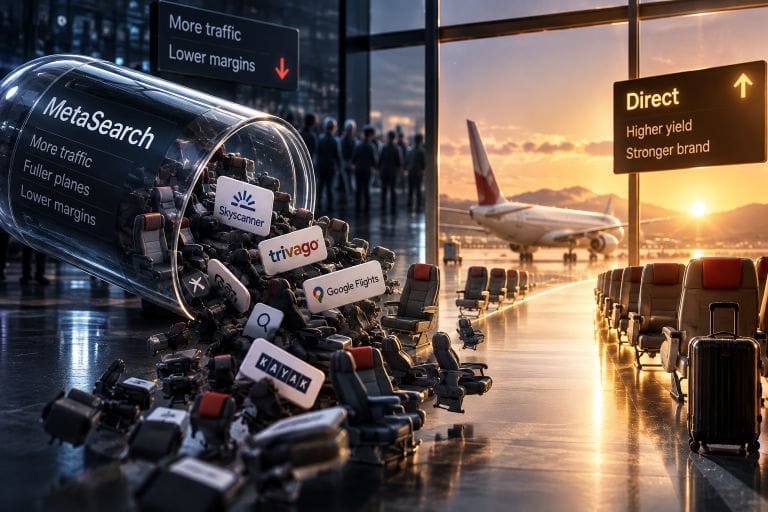
Commercial teams at airlines and large OTAs share a predictable seasonal ritual. They walk into the boardroom with glowing slides and demand more budget for metasearch.
Their argument sounds bulletproof. Look at the charts, we sold two thousand more seats than last month. Flights depart full, and executive leadership is thrilled.
Once you strip out acquisition costs in an overheated auction, payment processing, refunds, and support costs, the picture flips. We had effectively subsidized a flight for the least loyal passengers in the market.
A metasearch engine is not a brand partner. Its business model exists to force carriers into a single spreadsheet where price is the primary variable.
To a user on Skyscanner, Kayak, or Google Flights, a twenty-year operational history, reliable post-booking support, and loyalty tiers barely register. The decision hinges on price, schedule, and a few basic filters. You hold the top spot only as long as your fare is the lowest. The moment a competitor undercuts you by a couple of dollars or shaves thirty minutes off a layover, your traffic vanishes.
Airlines get hooked on this tool instantly.
When a regional flight is scheduled to depart in forty-eight hours with an empty cabin, metasearch acts as a handy emergency valve. You lower the fare bucket, pick up twenty passengers, and cover fuel burn and airport handling fees.
The breakdown occurs when commercial teams treat that emergency valve as a permanent distribution strategy.
Managing metasearch campaigns firsthand, I watched a consistent pattern unfold month over month. Metasearch steadily climbed as a share of total bookings. When that share hit 40 percent, we pulled the historical numbers from the previous season to see where that growth was actually coming from.
The findings were sobering. Total bookings had not increased at all. Every booking gained by metasearch was matched by a booking lost on our own website.
The platform was not delivering net-new market demand. It had inserted itself between our website and customers who had already decided to buy from us.
When we inspected the raw booking logs, the mechanics became obvious. The vast majority of these acquired customers had already visited our direct website one or two days prior to booking. They had picked their flights and finalized their travel dates, then opened a metasearch tab simply to verify the price. Under last-click attribution, the aggregator claimed full credit for the transaction.
At that point, marketing usually retreats into its favorite defensive playbook.
Enforcing strict contractual bans on bidding against our brand name in search ads was step one, but that solved very little. We shortened the attribution window to three days and credited metasearch only when it remained the final paid touchpoint across that entire timeframe. It still did not protect our margins. The channel kept skimming off our existing direct demand and handing us the invoice.
So we shut the channel down completely.
The commercial department predicted empty cabins and collapsed revenue. The outcome was clear. After shutting down metasearch completely, we recovered 100% of our original sales volume through our direct website within three months. We had no intermediary and no acquisition fee on passengers who were already planning to fly with us. With the same passenger volume, our net margin per seat rose by 14 percent, simply because we stopped paying a toll on our own organic demand.
Metasearch has its place in aviation distribution. But it should be managed like a rented crane on a construction site, not the foundation of the building. You rent it for a few days to lift a heavy beam into place, but you do not move into the cab.
Before authorizing another seasonal metasearch push, ask commercial leadership two simple questions.
First. What happens to total route bookings and contribution margin if you pause paid metasearch for fourteen days? If total bookings barely move while direct bookings absorb the volume, you were paying a platform to intercept customers who were already heading your way.
Second. What is the net yield per seat after factoring in channel fees, payment processing, refunds, and support? Carrying a full cabin of near-zero margin passengers makes sense only if you have figured out how to sell bottled water at the price of jet fuel. In every other scenario, it is just expensive theater to keep the board happy.